From mine to port of destination with no blind spots: the traceability challenge that the regional mining industry has yet to solve
By Patricio Rojas Ábalos | Co-Founder & CEO of Antara
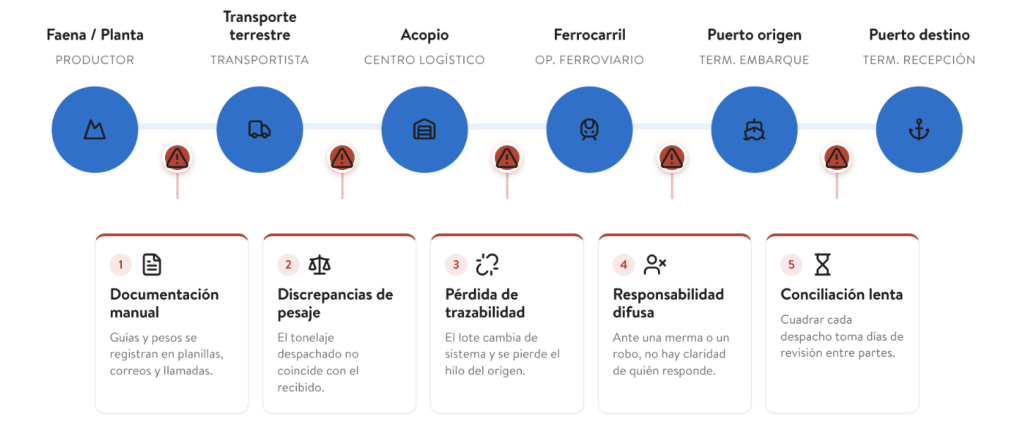
The movement of mining products from the mine mouth to final shipment or delivery is often depicted in flowcharts as a straight, seamless line. Those on the ground know that the reality is quite different. It doesn’t matter whether the operation ships copper, molybdenum, or zinc concentrate, cathodes, anodes, or any other valuable product, nor whether it does so by truck directly to the port, by rail, or using a combination of transport modes. The underlying problem is the same: every time the product changes hands, there is a risk of losing visibility and traceability.
And in a supply chain involving so many players—carriers, quality control labs, warehouse operators, and port terminals—that link breaks more often than official reports indicate. Furthermore, all the checks between points (such as port receipts) take an extremely long time, since they are done almost entirely by hand.
Why is it so difficult to achieve true end-to-end traceability, and what challenges can technology already address?
1. The loss of visibility with each change of custody
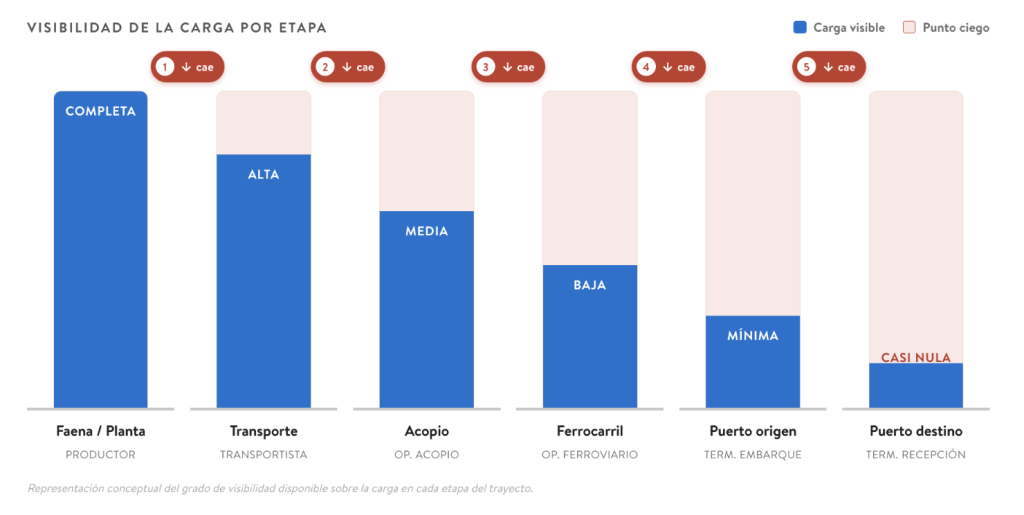
The first major problem doesn’t necessarily occur when switching modes of transport. It occurs at any point where the product is transferred from one party to another: from the mine to the carrier, from the carrier to the port warehouse, and from the warehouse to the final shipment or dispatch. Each of these transfers presents an opportunity for data to be lost, delayed, or contradicted.
Only 6% of companies report having full visibility into their supply chain. In the mining industry, where every ton has a traceable market value, that figure should be unacceptable.
It’s not enough to know that 100 units of ore were shipped and 98 arrived at their destination. Modern operations require knowing exactly which two are missing, where they are, and which production batch they belong to. That level of detail can’t be improvised; it requires that every transfer point be integrated into a single real-time data stream, regardless of who operates that point.
2. The Trap of Technological Fragmentation
A common mistake in the industry is attempting to solve this problem with custom-built solutions, which end up creating silos of information that lack support and quickly become obsolete. A typical operation requires the software to communicate simultaneously with weighing systems on scales or process control systems, the corporate ERP, quality and composition data from the laboratory, and logistics operators.
When these systems aren’t natively and automatically integrated, operations teams end up duplicating efforts and manually entering data. The consequences are predictable: 3 out of 5 operations detect losses or damage to their shipments only after delivery (or simply fail to detect them at all). I have seen this in operations of varying sizes, with different products and logistics setups across the region: the symptom is always the same, even if the physical setting differs.
3. The Struggle of Month-End
The clearest sign of poor visibility occurs at the end of every month. Logistics and metallurgy teams can spend entire days cross-checking data to finalize production figures (wet weight, dry weight, moisture content, grade, metallurgical composition), regardless of the product they handle.
The problem isn’t the complexity of the process. It’s the tool used to carry it out: 88% of spreadsheets contain at least one error. In a mining operation’s month-end balance sheet, that error isn’t an IT problem—it’s a financial problem. And if there is no auditable, automated history of change control, any discrepancy between what is shipped from the mine and what is received at the destination sparks endless debates that delay strategic decisions and damage the company’s reputation in the market.
A well-executed reconciliation shouldn't take more than a few minutes. If it takes days, that's a sign of architectural issues, not operational complexity.
The Path to Digital Certainty
The solution does not lie in adding more manual control processes. It lies in implementing mature commercial platforms—products with a proven track record in similar operations—that automate the entire product lifecycle from the mine to its final destination, providing visibility at every intermediate point and end-to-end traceability, including the return of containers and cargo units.
At Antara, we’ve been doing exactly this for years with Antara MP —a specialized platform that unifies the physical and digital flow of mining products, integrating scales, processing systems, field readers, laboratory systems, logistics operators, and destination systems into a single automated workflow, from mine to port and beyond. What invariably surprises teams is not the technology itself, but how quickly, simply, and efficiently it transforms day-to-day operations, eliminating dozens of Excel spreadsheets and emails in the process.
The technology to achieve this exists and is mature. What is missing, in many cases, is the decision to stop just patching it up.
How do you currently manage visibility in your shipping process? Is month-end closing still a labor-intensive process involving manual spreadsheets, or have you already made the switch to automation? Let me know in the comments.
Sources: Zippia Supply Chain Report, Tive State of Visibility 2025, University of Hawaii Spreadsheet Research.
#LatinAmericanMining #MiningLogistics #SmartMining #SupplyChain #Traceability
Continue reading
Demurrage in Mining: The Contract Covers the Cost; Traceability Prevents the Problem
July 14, 2026
Over a decade of connecting with the mining industry: What the screen can't solve
May 31, 2026